


CT Logo
effect

Every Release Is a Reputation Decision.

Quality engineering that gives your team the confidence to release frequently, scale reliably, and deliver experiences your users trust, every single time.
Quality isn't a gate before launch. It's how your team moves fast without breaking things.

Functional Testing

Every feature validated against real user scenarios, not just the happy path. The flows your users actually take, the edge cases they'll hit, and the error states they need to recover from gracefully.


Image 1
Image 2

Test Automation

Automation frameworks your team can maintain long-term. Clear structure, reusable components, documented patterns, so the suite grows with your product instead of becoming a maintenance burden itself.

Image 3

Performance & Load Testing

Your application works at current traffic. But what happens at 5x? 10x? During a product launch, a seasonal spike, or a viral moment? We simulate real usage patterns and find the limits before your users do.

Image 4

Security Testing

OWASP-aligned assessments, penetration testing, and vulnerability scans running inside your CI/CD pipeline. Security validated continuously with every release, not reviewed once before go-live and forgotten.

Image 5

API & Integration Testing

Your APIs connect systems your business depends on. We validate data integrity, error handling, authentication flows, and response behavior under load, because silent API failures cause the loudest business problems.


Image 1
Image 2

Mobile Testing

Consistent experience across devices, OS versions, screen sizes, and network conditions. Tested the way your users actually use their phones: on spotty connections, mid-task, switching between apps.


Image 3

Challenges that slow quality delivery

Testing only happens before release.

By then, the deadline is fixed and the pressure is on. Issues found late get shipped anyway, or the release slips.

Automation exists, but trust doesn't.

Tests that fail randomly aren't providing confidence; they're creating noise. A well-structured framework changes that.

Changes trigger unknown regressions.

That's a regression testing problem. And it's the reason teams slow down instead of speeding up as the product grows.

The Cost of finding bugs later

In Design

A label change. A wireframe tweak. Minutes of work, and no one downstream ever knows.

In QA

Regression testing. A release pushed back. The team scrambling to ship anyway.

Hands holding an illuminated light bulb, a metaphor for catching costly bugs before production
In Development

A code rewrite. Another peer review. A sprint quietly slips.

In Production

A hotfix under pressure. Downtime. Support tickets piling up, and user trust you don't get back easily.

What changes when quality engineering is in place?

Without QA strategy

Sprint ends, then three days of manual testing. The release slips, the team scrambles on Friday, and someone's monitoring all weekend.

With QA strategy

Automated tests run on every commit. Instant feedback, on-time releases, and the team actually goes home.

Without performance testing

Campaign traffic spikes, the app slows down, users abandon. You find out from customer complaints, not your monitoring.

With performance testing

Traffic simulated before launch. Bottlenecks fixed early. The campaign drives engagement, not incident tickets.

Without test automation

200 manual test cases, every release. An exhausted team, inconsistent coverage, and regressions slipping through.

With test automation

The same 200 cases run in 20 minutes. The team focuses on exploratory testing, coverage stays consistent, bugs caught before staging.

What makes our Quality Engineering different?

We don't test everything. We test what's most likely to break, and most costly when it does.

01
Test Strategy First

Prioritize risk before testing

Identify high-impact and high-risk areas early, so testing focuses where failures matter most from the start

02
Built to Be Owned

Built to Be Owned

Structured automation with clear documentation and naming ensures your engineers can scale and maintain it independently

03
Test What Matters

Focus on business impact

Prioritize high-risk, revenue-critical user flows over superficial coverage to ensure testing delivers real business value

04
Measure What Matters

Track real product outcomes

Evaluate quality through release frequency, production stability, and time-to-fix, not vanity metrics like test case counts

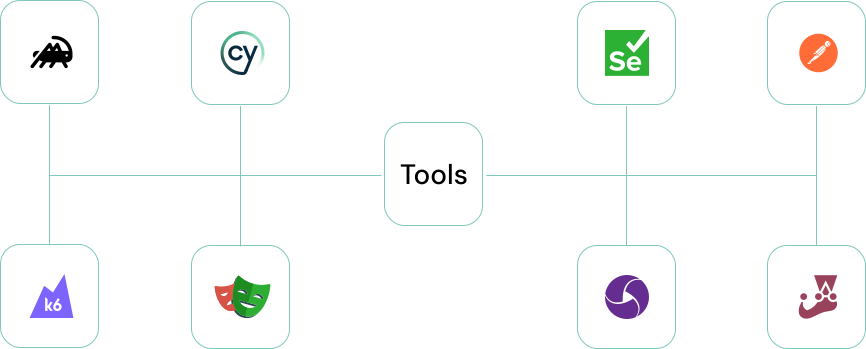
Tools we work with

tools image

Featured Work

The systems behind millions of users, where uptime and scale aren't optional.

Platform Scaling

SaaS platform hitting limits. → 1M+ users, near-zero downtime after AWS migration.

  • Platform Engineering
  • AWS
  • Microservices
Featured Work 1

High-Scale Sports Platform

Fantasy platform for live matches. → 6M+ concurrent users, zero downtime.

  • Performance Engineering
  • Real-Time Systems
Featured Work 3

AI Document Processing

Hours per shipment on manual processing. → Minutes with multi-agent AI.

  • AI Solutions
  • Multi-Agent
Featured Work 2

Releases Should Feel Like Progress, Not a Risk

Tell us about your product, your release cycle, and what keeps going wrong. We'll share where the gaps are and what to fix first.