

Trust Is Now a Line Item: Responsible AI Just Became a Procurement Requirement
 Vidhyesh Patil
Read Summarized version with


Trust Is Now a Line Item: Responsible AI Just Became a Procurement Requirement
Two vendors pitch the same enterprise. Same underlying models. Demos that look nearly identical. One signs in a few weeks. The other spends three months in a security and governance review and walks away with nothing.
The deal was not lost on features. It was not lost on price. It was lost because one vendor could produce evidence of how its AI is governed, and the other could only point to a page on its website that said it took ethics seriously.
That is the shift. In 2026, responsible AI stopped being a values slide and became a gate you either pass or fail.
For a few years, "responsible AI" was a communications exercise. A page of principles. A line in the keynote. It cost nothing to publish and bought a little goodwill.
Then AI started taking actions inside regulated workflows, and buyers responded the way they always do when risk enters the picture. They added it to vendor due diligence. The questions an enterprise now asks before signing have shifted from what your AI can do to how your AI is controlled.
Three instruments are driving this, and they are real, current, and increasingly non-optional:
- ISO/IEC 42001, published in 2023, is the first certifiable AI management system standard. Because organizations can be independently audited against it, procurement teams treat it the way they already treat SOC 2 and ISO 27001: as evidence they understand. AI vendors have begun certifying specifically to clear enterprise buying reviews.
- The NIST AI Risk Management Framework is voluntary, but its influence far exceeds its status. It is referenced in federal procurement guidance and cited across regulatory agencies, and enterprise buyers use its vocabulary (Govern, Map, Measure, Manage) as a baseline for vendor due diligence.
- The EU AI Act carries the teeth. High-risk obligations under Annex III become enforceable on 2 August 2026, covering systems in areas like employment, critical infrastructure, and essential services.
The common thread: governance is now something a buyer inspects, not something a vendor asserts.
Why Principle-Era Responsible AI Fails the Review?
A values statement answers a question nobody in procurement is asking. The security and legal reviewers running a vendor assessment are not looking for your intentions. They are looking for artifacts.
When the questionnaire arrives, "we are committed to fairness" is not an answer. "Here is our bias testing methodology and the results from the last quarter" is. The gap between those two sentences is the gap between a vendor that signs and a vendor that stalls.
This is why the scrutiny is laddered. Not all evidence carries equal weight in a buying decision.
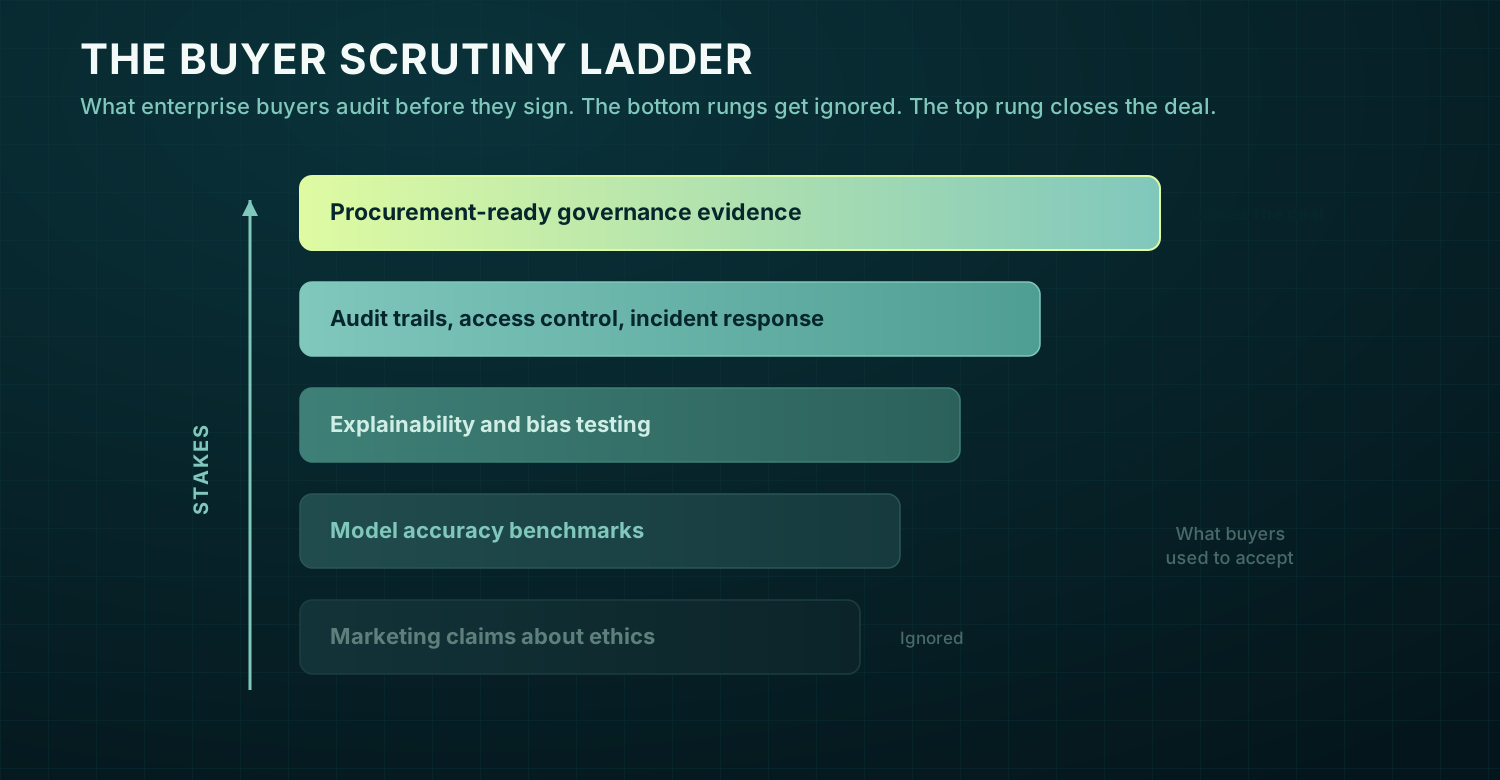
The bottom rungs are what buyers used to accept. The top rungs are what they now require. A vendor that lives at the bottom of this ladder is invisible to the people who actually sign the contract.
What "Procurement-Ready" Actually Means?
If you sell AI into the enterprise, this is the evidence the review will ask for. It is also, not coincidentally, what good engineering produces as a byproduct.
- Data handling and residency. Where data goes, who processes it, what is retained, and for how long.
- Access control for non-human actors. When an agent can act, the buyer wants to know what it is allowed to touch and who authorized it.
- Audit trails. An immutable record of what the system did, when, and on whose instruction. If you cannot reconstruct a decision, you cannot defend it.
- Evaluation and bias testing results. Not a promise of accuracy, but measured evidence of it, repeated over time.
- Human oversight design. A clear account of where a human approves, where a human monitors, and where the system acts alone.
- Incident response and notification. What happens, and how fast the buyer hears about it, when something goes wrong.
- Third-party and sub-processor disclosure. Which external models and services sit inside your stack, because your supply chain is now part of the buyer's risk.
- Framework alignment. A mapping of the above to ISO/IEC 42001, the NIST AI RMF, or the EU AI Act, in the language procurement already speaks.
Signs Your AI Will Stall in Procurement
If more than one of these is true, the next enterprise review will be slow and may not end in a signature.
1. Your governance lives on a webpage, not in the system. Principles are published, but nothing is instrumented.
2. You cannot show who or what accessed which data, and when. No audit trail means no defensible answer to the first hard question.
3. You have evaluation demos, not evaluation evidence. The system performs in the pitch and cannot prove it performs anywhere else.
4. No one owns AI risk. When governance is "everyone's job," it is no one's artifact.
5. Your answer to the security questionnaire is a sentence about caring. Reviewers read that as the absence of a real answer.
Key Takeaways
- Responsible AI has moved from a marketing principle to a procurement gate. Buyers inspect it before they sign.
- ISO/IEC 42001, the NIST AI RMF, and the EU AI Act are the instruments buyers reference, and EU high-risk obligations are enforceable from 2 August 2026.
- A values page is not evidence. Procurement asks for artifacts: audit trails, evaluation results, access controls, oversight design.
- Governance that is engineered into the system is also the governance you can prove. The two are the same work.
- The vendor that can produce evidence clears the review. The one that cannot loses to a competitor with the same model.
Where CoderTrails Fits
We are a software technology company, and Responsible Engineering runs through how we build. That means we engineer governance into the system from the start: audit trails, access control for agents, evaluation, and oversight designed in, not bolted on once a buyer asks for it. The result is an AI system that does its job and can prove how it does it.
If your AI is strong in a demo but you suspect it would stall the moment an enterprise security review asked how it is governed, that is a solvable problem. Your first conversation is with the founder, not a sales desk.
Start that conversation here.
Frequently Asked Questions
What does it mean that responsible AI is now a procurement requirement?
It means enterprise buyers evaluate how your AI is governed as part of vendor due diligence, the same way they already evaluate security with SOC 2 or ISO 27001. Governance has moved from a marketing statement to a gate in the buying process, and vendors who cannot produce evidence increasingly lose deals to those who can.
Is ISO/IEC 42001 mandatory?
No. ISO/IEC 42001 is a voluntary, certifiable standard for AI management systems. But it is increasingly expected. Enterprise buyers reference it in vendor assessments alongside SOC 2 and ISO 27001, and certification gives procurement teams evidence of governance maturity in a format they already understand.
What is the difference between the NIST AI RMF and ISO/IEC 42001?
The NIST AI Risk Management Framework gives you a flexible structure for managing AI risk, organized around Govern, Map, Measure, and Manage. ISO/IEC 42001 is a certifiable standard you can be independently audited against. Many mature programs use both: NIST to structure internal risk management, and ISO 42001 to certify and demonstrate it externally.
When does the EU AI Act apply to my AI?
It depends on risk classification. Obligations for high-risk systems under Annex III, which include areas like employment, critical infrastructure, and essential services, become enforceable on 2 August 2026. If you sell into the EU or to customers who do, classification is the first step.
We are a vendor. What do we need to pass an enterprise AI security review?
At minimum, expect to provide documentation of data handling, access controls including for autonomous agents, audit trails, evaluation and bias testing results, human oversight design, and incident response, ideally mapped to a recognized framework. The review is looking for artifacts, not assurances.
Is a responsible AI policy page enough?
No. A policy page states intent. Procurement asks for evidence. The two are different things, and the gap between them is where deals stall. The page is fine as a public statement, but it does not answer a single question on a vendor security questionnaire.
Does building governance in slow you down?
Not the way teams fear. Most of what procurement asks for, such as audit trails, access control, and evaluation, is also what makes a system reliable and debuggable. Engineering it in produces both the governance you can prove and the system you can trust. Bolting it on later, under deadline, is the slow path.